
Microsoft Fabric in Regulated Environments: Architecture First, Platform Second

What does it take to adopt Microsoft Fabric in an environment governed by strict security, compliance and network requirements? More often than not, the answer lies less in the platform itself and more in the architecture that supports it.
Modern analytics meets enterprise reality
Modern data platforms promise faster insights, greater scalability and a unified approach to analytics. Microsoft Fabric implementations are already built on strong security foundations. For some organizations, however, out-of-the-box platform capabilities are not enough. Additional architectural controls, governance requirements and network constraints often arise from regulatory obligations, sector-specific requirements and strict internal security policies.
This is especially common in industries such as financial services, healthcare and the public sector, where organizations may need to comply with regulations and frameworks such as NIS2, DORA, GDPR or ISO 27001. In these environments, the question isn’t whether Microsoft Fabric is secure. The question is how to adopt Fabric while maintaining the governance, security controls and auditability that the organization requires.
Most organizations have spent years establishing security architectures based on controlled access, strict network boundaries and carefully governed integrations. Any new platform must operate within those constraints while still enabling modern analytics capabilities.
Rather than starting from individual security features, we began with a set of architectural principles:
• Security-first architecture
• Outbound-only connectivity
• Environmental segmentation
• Identity-based access control
These principles are not unique to Microsoft Fabric, which is precisely the point. The most important security decisions are architectural, not platform specific. This foundation helped us shape an architecture that provided the desired analytics capabilities without compromising the security and compliance that were expected.
Security starts with boundaries
One of the most valuable lessons from cloud data projects is that security rarely comes from individual features alone. It emerges from architectural decisions that define how users, systems and services interact with one another.
When discussing data platform security, conversations often focus on encryption, governance and access management. All of these are important. However, the fundamental question is how responsibilities are separated across the architecture.
Who can access the platform? How does data move between systems? Which systems are responsible for which tasks?
Rather than treating the platform as a single connected environment, we designed it around clearly defined trust boundaries. Development environments, integration services, source systems and cloud services each had their own specific role. Source system access was routed solely through gateway services, while development work took place in a separate environment with its own permissions and purpose. This approach aligns closely with established architectural principles such as least privilege, environment separation and controlled integration points.
These same boundaries also influenced how connectivity was designed. If responsibilities are separated across the architecture, network traffic should follow the same principle.
What happens when nothing can connect in?
One of the first questions raised was also one of the most important:
Does adopting Microsoft Fabric mean opening inbound connections into the internal network?
The answer was no.
The architecture was designed so that communication with internal source systems originated from the internal network. Source databases remained inside the organization’s network, while data moved through an On-premises Data Gateway layer that established encrypted outbound connections to Microsoft Fabric. Fabric never connected directly to the source systems.
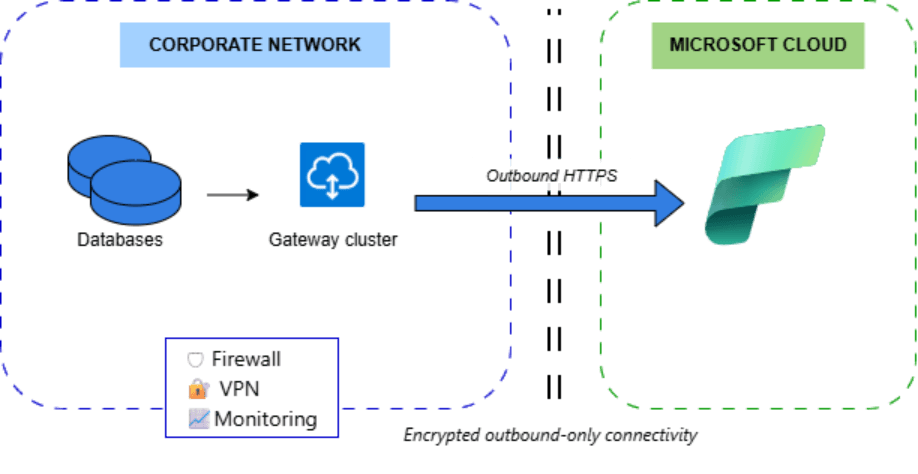
Figure 1. Data access is initiated from inside the corporate network through an encrypted outbound connection. Microsoft Fabric never connects directly to source systems
Access to Fabric itself was also controlled through the organization’s private network. Users first connected to a managed environment within the customer network and accessed Fabric through approved outbound proxy and firewall paths, with access limited to allowlisted public IP addresses. This meant that Fabric operated as part of the organization’s controlled access model rather than being accessed directly from unmanaged devices.
While this sounds like a technical detail, it has major implications for governance and risk management. Existing firewalls, proxy, VPN and monitoring controls can remain intact. Internal systems stay isolated from the cloud, user access follows controlled network paths, data movement follows outbound-only routes, and the organization avoids making exceptions to existing security principles.
The same logic applied beyond connectivity. If network traffic needed controlled paths, then development, testing and production also needed clearly separated responsibilities.
Developers shouldn’t be part of the production data path
Another principle emerged early in the design process: solution development and production data movement should not be mixed.
Many organizations gradually blur this boundary. Development environments gain access to production systems, temporary workarounds become permanent and responsibilities begin to overlap. Individually these decisions may seem harmless, but over time they increase operational risk and make environments harder to govern and support.
The architecture therefore kept developers out of the production data path. Developers used Microsoft Fabric and Power BI to build solutions, but changes were version controlled and deployed through Azure DevOps pipelines. Production data movement remained the responsibility of a dedicated integration layer.
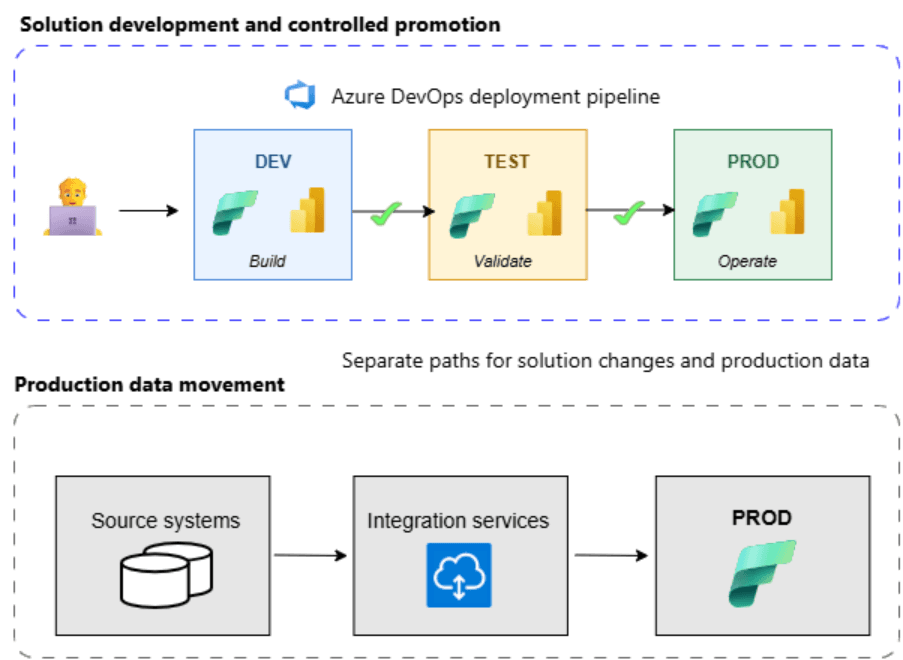
Figure 2. Solution development and production data movement remain separated. Changes are promoted through controlled DEV, TEST and PROD environments, while production data movement is handled by dedicated integration services.
The platform was built around dedicated DEV, TEST and PROD environments. Changes were developed in DEV, validated in TEST and promoted to PROD through a controlled deployment process. Each environment had its own resources, configuration and access model.
This separation makes the platform easier to govern, support and audit. Developers focus on building solutions, deployment pipelines provide controlled promotion, and integration services handle production data movement. Dedicated environments are therefore not only a development practice, but also an important part of risk management.
Identity matters more than location
With connectivity, responsibilities and environments clearly separated, the next question was who should be allowed to access what. Traditional security models focus heavily on networks and system boundaries. Those controls still matter, but cloud platforms increasingly place identity at the centre of the security model.
Access was not controlled by network location alone. Users still accessed Fabric through the organization’s private network, but permissions were based on identity, role and responsibility.
This is where clear ownership, role-based access control and the principle of least privilege become especially important. The platform adopted a straightforward access model based on roles and responsibilities, with separate permissions for administrators, developers and business users.
Beyond security, clear ownership and access models reduce operational complexity, simplify governance and help ensure that sensitive information is available only to those who need it.
Architecture first, technology second
At the beginning, the question was not whether Microsoft Fabric could support analytics, reporting or future AI use cases. Nor was it whether a Fabric implementation could be secure.
The more relevant question was how to introduce a modern analytics platform in an environment where governance, regulatory obligations and data sensitivity required additional safeguards and oversight.
The answer was architectural rather than technical. By focusing on clear boundaries around connectivity, environments and identity, it was possible to introduce modern analytics capabilities without creating exceptions to existing controls.
Outbound-only connectivity, dedicated environments, controlled deployment paths and role-based access are not Fabric specific. They are established architectural patterns that help organizations operate cloud platforms within existing governance and compliance frameworks.
The question is not only whether the platform is secure. It is whether the organization can trust how it is accessed, operated and governed. In regulated environments, architecture is what makes trust visible.