
“Don’t slop me, bro!”: The Emerging Etiquette of Generative AI
Some of us still remember when the internet was new. Among the many other changes, casual communication leaped from voice and handwritten text to typing, and with it, new norms developed, which included (for those who didn’t know the rules) all-new ways to embarrass yourself or offend your audience. Most couldn’t know intuitively that all-caps typing was “shouting.” They needed to be told, and if they were unlucky, the message would only arrive after they’d already broken the rule.
Generative AI is once again changing the way we communicate and, as such, brings new norms and etiquette. Gen AI offers new opportunities for efficiency in our online interactions, but as AI users or solution designers, we need to keep our eyes on the danger: Sometimes, the time you save is time someone else spends sorting through your output. Other times, efficiency defeats the very point of the operation.
In this blog post, I’ll break down when and how this becomes a problem, focusing on the idea of “slopping” and recognizing when the process, not the output, was the whole point.
Slopping: Work saved or work transferred?
You’ve probably heard of the noun phrase, “AI slop.” The term loosely describes hastily generated, low-quality AI content. Whole blogs, YouTube channels, and social media accounts arise every day with nothing but uncurated AI output. From the creator’s perspective, AI slop is efficient and easy to make: You just ask an AI for content and then submit whatever it provides.
Now, quick AI content has its place. There is no inherent etiquette fail in a quick AI job. That one-time-use code snippet or the document summary for your personal use may not need much curating, editing, or multiple iterations. Feel free to ask once, look it over quickly, and use it (within reason). Just be wary of passing it to someone else.
If you do, “slop” can sometimes become an etiquette issue. It becomes a verb: “slopping.” What I refer to here as “slopping someone” is the act of sending raw generative AI content to another person without sufficient personal review. The problem is more fundamental than making someone look at something lazy or unpleasant. It uses generative AI to save you effort, but in a way that creates more work for others. Instead of saving time, you’re giving your work to someone else.
This can take many forms. For example, maybe that AI-generated email sounds all pretty and formal, but it’s really just extra words without extra content. Or that article might take your editing team twice as long to read over because you didn’t take the time to reread and fact-check yourself. Or maybe that code you submitted really needed several more rounds of iteration and testing, not to mention a little manual scrutiny. The list goes on.
Offloading your responsibilities to others, especially when it’s not their job, is an etiquette failure in any form. Be aware of the downstream impact of your process. Don’t slop people.

When the process is the point
Usually, in a creative process, the output is the point. Sometimes, however, the goal is the process itself.
Nowhere is this as obvious as with schoolwork. Nobody wants a student’s term paper on World War II, for example: The teacher literally needs to be paid to read it. But the point isn’t the paper. The point is what the student learns along the way. If an AI writes the paper instead, the student doesn’t have to learn anything, and the assignment is meaningless, regardless of the paper’s quality.
Less obviously, this same principle applies in many other areas. For example, messages that express personal sentiments are gestures of thoughtfulness, showing that you are aware of someone else’s life and their feelings and are willing to devote time to them.
Automating these sentiments can undermine that, at least if the automation is apparent. Anything that suggests you spent extra time on the message is flattering. By contrast, anything that suggests you spent less time than expected lowers the value and may even be insulting to some viewers.
Birthday messages provide a good example. Wishing someone a happy birthday is not a high-effort process, but taking the time to do so can be polite (specifically building what linguists refer to as positive face). Depending on your culture and your relationship to the individual, of course, there may be other obligations.
Anything that exceeds the minimum is extra effort and therefore a stronger sentiment. However, even for a distant acquaintance for whom you have little obligation, it is possible to go below the bar.
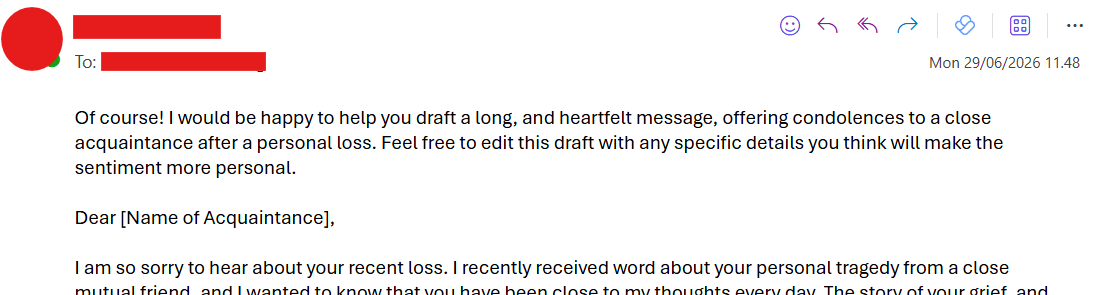
For example, imagine sending an email that starts with:
“Certainly! Here is a lengthy, well-composed birthday greeting you can customize to wish someone well on their special day:
Dear [Recipient’s name],
Happy birthday! I wanted you to know how much I value our time together…”
Pragmatically, this is worse than no message. If the recipient wasn’t worth the effort of reading the message before sending it, why did you send it at all? The usual answer is that you felt obligated. Now, instead of suggesting the recipient is valued, you have inadvertently labeled them as a burden, a task to be gotten out of the way before you move on to more important matters. You didn’t care enough to read the message. You sent it because you had to.
Worse, you obviously thought reading the message before sending it was a waste of time. You sent it anyway, however, meaning you expect them to read it. Ergo, you are deliberately wasting their time.
This becomes a bigger issue with messages that aspire to stronger sentiments. An AI-crafted message may suggest only minimal engagement on your part, which can make stronger claims seem facetious. Long letters of praise or admiration, condolences for personal losses, and so on, are expected to take time. Saving that time can invalidate the very sentiment they seek to express. That’s why a long, heartfelt letter that sounds AI-generated may feel hollow or even insulting to the recipient’s intelligence. The sentiments aren’t yours, and the reader feels tricked or lied to.
Of course, the literal time spent is less important than what the message signals about attention and care. Unfortunately, unless you have a truly extensive backlog of writing samples available, an AI is unlikely to match your writing style well enough for others not to know the difference. In the present climate, even if carefully iterated, a heartfelt message in an AI voice may signal a lack of interest, on your part, in spending time.
This doesn’t mean that AI can have no place in personal messages, of course. A carefully-iterated, customized AI image can show more thought in a birthday greeting than a GIF copy/pasted from a Google search, for example. Just be wary of appearing to save time when spending time was the whole point.

Generative AI etiquette for autonomous agent developers
In the end, this breaks down to three key rules:
- Respect others’ time.
- Show other people that they’re worth yours.
- Don’t assume output is the only part of process value.
This applies as much to AI automation as individual use. Workflows should output concise, high-quality, easy-to-digest content, both for efficiency and to respect your end users’ time. Likewise, that personal agent that checks your calendar and sends out birthday and holiday greetings may make the messages seem less meaningful than you intend. You should also be wary of cases where automation negates an important part of the service. That repetitive process you’re trying to automate might be relaxing and an important way for workers to destress. If so, removing it may make their day worse instead of better. Focusing too much on outcomes can cause us to lose track of when the means themselves were valuable.
Conclusion
These rules aren’t new, but the way they apply takes on new dimensions in the world of generative AI. Avoid slopping people, and don’t save time when you should be spending it.
In both cases, how the AI manages effort influences how the messages are received. Either the effort shifts to the audience or the effort itself was valuable, and that value is lost.
The rules above aren’t the final word on AI etiquette, but they are norms emerging worldwide in AI social interactions. Politeness strategies like this always arise after a technology has been adopted, not before, and sometimes there can be awkwardness along the way. That’s fine! We’re still inventing the “no caps lock” rules for AI, and as anyone who remembers the “no talking on cell phones in public” rule can attest, those rules may change. The important thing is to always remember how our actions might be received and to consider others’ time and feelings, regardless of the tools we use to interact.