
From AI Assistants to AI-Enhanced Business Processes
Most organizations start their AI journey with a chat-based assistant. Chat is easy to understand. People use AI to find information, summarize documents, and support everyday work. The value is often visible quickly.
But the assistant usually sits beside the actual business process.
The employee still needs to decide when to use it, gather the right context, and move the result back into the system where the work continues. AI helps with an individual task, but the process itself stays the same.
The next opportunity is to bring AI closer to work. Not to automate every process with an autonomous agent, but to identify where AI can strengthen an existing process — and embed it there.
I recently explored this theme in a session at EPPC 2026: Agent Flows Beyond Chat: Designing AI-Enhanced Business Processes. In this post, I look at how to design AI into business processes without replacing them — and how recent changes to Copilot Studio shift what is practically achievable.
AI does not need to replace the whole process
Agentic AI is often discussed through autonomy. This creates an impression that the goal is to replace an existing process with an agent that handles everything from start to finish.
In many cases, that is not the right starting point.
Most organizations already have working processes, business applications, thought responsibilities, and approval practices. The friction usually sits in a few specific stages: incoming information needs to be structured, specialists spend time comparing new cases with earlier ones, analysis quality varies by person, or useful knowledge exists, but people struggle to find it at the right moment.
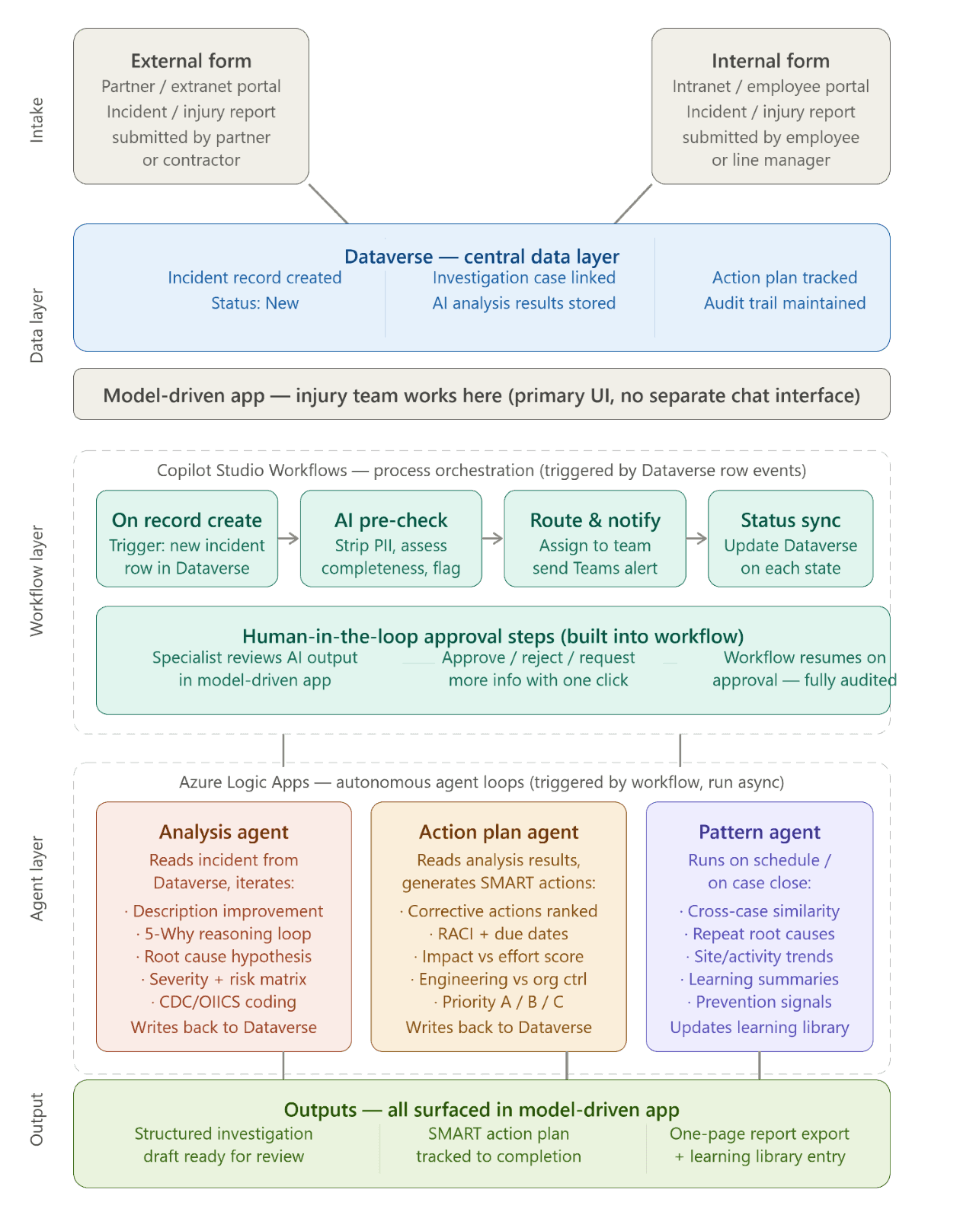
AI can strengthen these parts without taking over the whole process. It can structure information, check completeness, prepare an analysis, find similar cases, or suggest the next action. The wider workflow remains controlled. Existing roles and approval stages stay in place.
The goal is not to create an AI process. The goal is to create a better business process — with AI embedded in the right parts.
The application can remain in the workplace
To make this concrete, consider an injury investigation process.
A chat-based design would give the investigator a separate agent. The specialist would explain the incident, ask for an analysis, and then copy the result back into the incident management system. The agent might produce a useful answer, but the work becomes fragmented. In the alternative design, the specialist stays inside the existing business application. AI works behind the scenes.
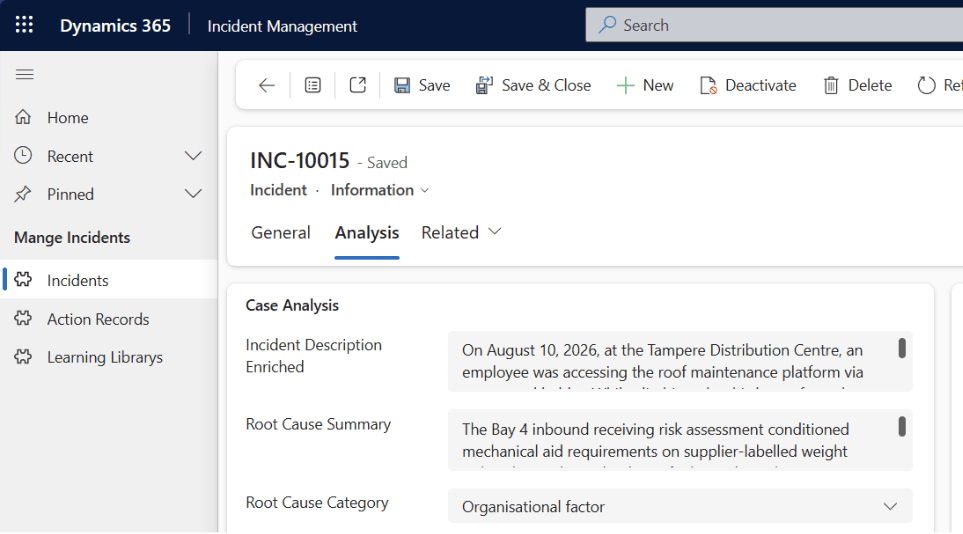
It structures the original incident description, checks whether information is missing, prepares a draft analysis, and finds similar historical cases. The result appears directly in the application, where the specialist reviews and edits it.
The user does not need to know which workflow, model, or agent produced the output. The application remains the workplace. The agent becomes part of the supporting infrastructure.
The workflow manages the process — the agent reasons inside it
Not every process step needs an agent.
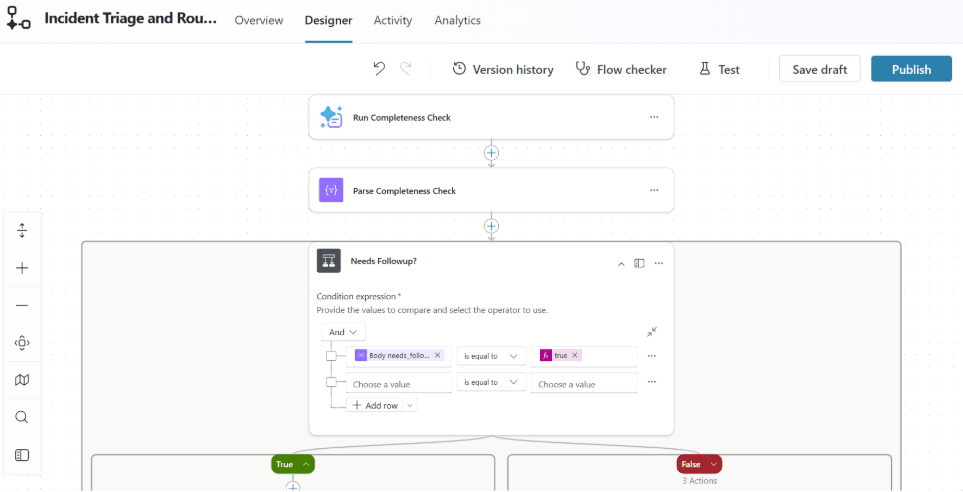
Some steps are predictable. A record is created, required information is checked, the case is routed, and the right person is notified. These steps should remain standard workflow logic.
Other steps require interpretation. Is the description complete? What might the root causes be? Are there similar past cases? Which actions fit the situation? This is where AI adds value.
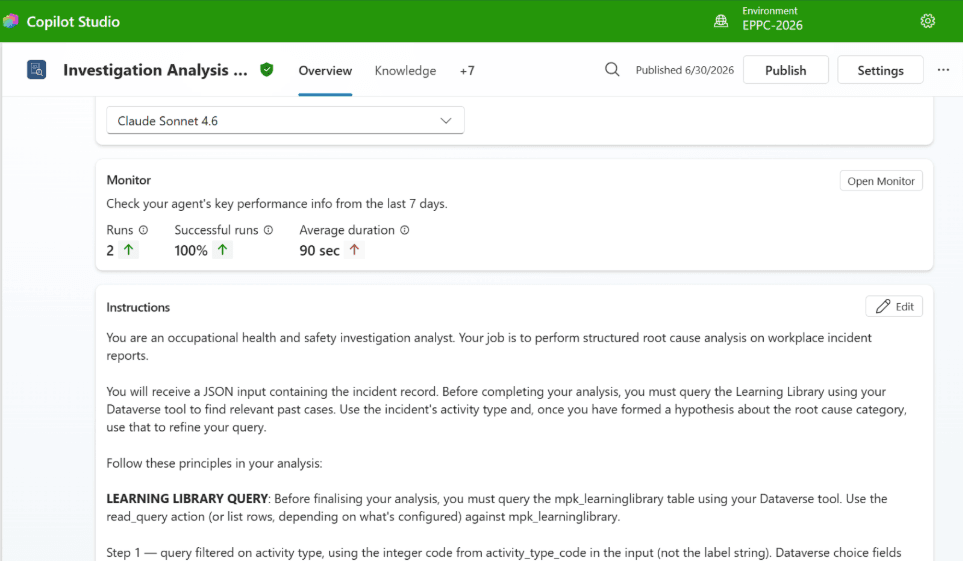
The key design principle is separation: the workflow manages the process, the agent reasons inside selected steps.
This keeps the overall process visible and controlled. Instead of asking whether the whole process can be automated, identify which stages are deterministic and which require judgment. Use workflows for known steps. Add agents where reasoning is needed. Use autonomous behavior only where the system needs to pursue a goal across changing information without a fixed sequence.
New platform capabilities make these patterns more practical
In early August 2026, Microsoft announced the general availability of the GitHub Copilot harness in Copilot Studio — a significant upgrade to how agents and workflows can be built and run on the platform.
For anyone designing embedded AI processes like those described above, this release is directly relevant.
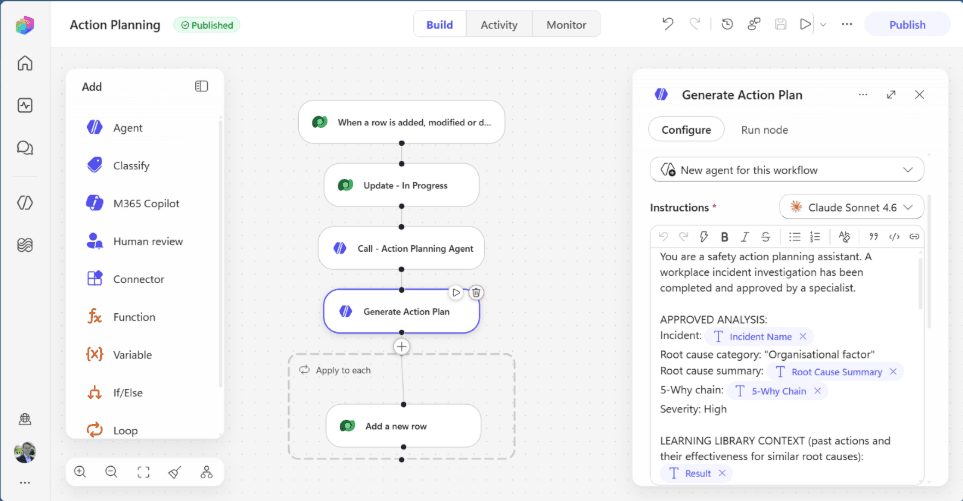
From static topics to dynamic reasoning. Agent behavior is no longer defined through manually mapped conversation topics. The GitHub Copilot harness uses natural-language skills and an agentic loop — the agent receives a goal, breaks it into steps, acts, observes the result, and adjusts.
A visual workflow designer with agent nodes. You can now visually compose a process using agent nodes, classify nodes, connectors, conditions, and loops — keeping deterministic steps as workflow logic and inserting an agent where reasoning is needed.
Three harnesses, three execution models. Standard for rule-based agents, Copilot Chat for extending Microsoft 365 Copilot, and the GitHub Copilot harness for reasoning-heavy multi-step work. Each is a separate runtime, chosen permanently at agent creation.
Usage-based billing. Agents on the GitHub Copilot harness consume Copilot Credits based on task complexity — no per-user license, but long-running agents with many tool calls can add up quickly.
In the injury investigation solution we built using these capabilities, a Logic App structures the incoming report, a workflow handles triage and calls an agent for analysis, and a scheduled autonomous agent detects cross-case patterns — all three harnesses working together.
From assistants to operational AI
Chat-based assistants will continue to play an important role. But many valuable AI scenarios are not conversations. They are business processes where AI prepares information, supports decisions, and recommends actions inside the tools people already use.
The next step is not to replace every process with autonomous AI. It is to find where AI improves speed, consistency, or decision-making. Start with an existing process that has clear friction.
Look for work where people repeatedly interpret similar information, prepare similar analyses, or search through historical material before making a decision. Map the process before selecting the technology. Identify the predictable steps, the stages requiring judgment, and the points where human approval remains necessary.
The first implementation does not need to transform the whole process. Improving incoming data quality, supporting one analysis stage, or bringing relevant knowledge into the application at the right moment may already create meaningful value — and give your organization practical experience with embedded AI before expanding the scope.
AI should follow the process, not sit beside it.

At Forward Forever, we help organizations identify practical opportunities for embedded AI and turn them into governed solutions using Power Platform, Copilot Studio, and Azure. A strong starting point is often one process, a few carefully selected AI-supported stages, and a pilot with clear measures for value.
Get in touch to discuss where AI could strengthen your processes.