
From Data to Decisions: The Missing Layer in Enterprise AI
Most organizations have already begun integrating AI in various ways. People utilize Copilot to draft content, summarize meetings, analyze documents, and streamline their daily tasks. Meanwhile, data teams are developing modern platforms, enhancing reporting capabilities, and working to make business data more accessible.
Still, there is often a clear gap between these two worlds. AI tools are used on one side, data and business systems live on the other, and the actual work still depends on people manually connecting the dots.
The manual handoff today: Someone reads a report → searches for background → asks a colleague → applies their own experience → decides what should happen next.
That is not necessarily a failure. It is simply where many organizations are today. But it also shows why AI often creates value for individuals before it creates value for operations.
The problem is not only access to AI
A generic AI tool can be very useful. It can help people write faster, understand documents more quickly, and reduce some of the routine work around communication. But when we move from personal productivity to business decisions, the requirements change.
If a sales manager asks “which customers are at risk this quarter?”, the answer cannot come from a generic model. It needs current pipeline data, customer history, open service cases, relevant product information, and the organization’s own rules for handling such situations.
This is where many AI initiatives become more difficult. It is not enough that the AI can produce a fluent answer. It needs to know what is happening in the business, what context matters, and what the next step should be, according to the way the organization works.
AI needs data, knowledge, and process understanding
For years, organizations have invested in data platforms, reporting, and analytics. That work becomes even more important in the AI era, because agents are only as good as the data and knowledge they can access.
If enterprise data is fragmented, outdated, or poorly governed, AI does not magically fix the problem. In many cases, it makes the weakness more visible. A report based on unclear data is already a problem — but an agent giving confident answers based on unclear data is an even bigger one.
However, data alone is not enough. In real business scenarios, AI usually needs three types of context:
| Context type | What it answers | Examples |
| Structured data | What is happening | Sales pipeline, revenue, margin, inventory, open tickets, and delivery performance |
| Business knowledge | The situation around the data | Meeting notes, account history, contracts, product documentation, service case summaries, policies, internal instructions |
| Business process knowledge | How the work should be done | Decision points, roles, approvals, handovers, exceptions, escalation rules, which system to update, and where human approval is required |
The third area is easy to underestimate. Many organizations have process knowledge, but it is often inside people’s heads, scattered across documents, or hidden in old ways of working. If we want agents to support real work, we need to describe that work clearly enough for AI to follow it.
This is where skills become important
In the Microsoft agent ecosystem, the word “skills” is becoming an important technical concept. But I also think it is a useful way to think about business process knowledge more generally.
A skill should not be seen only as a technical extension. In good agent design, a skill can package how a certain task should be handled — instructions, tools, resources, and process logic for a specific business activity.
Take an account escalation skill. It should not only know how to create a task in a system. It should know:
- When escalation is actually needed?
- What information must be checked first?
- Who needs to be informed?
- What is the recommended next step?
- When to stop and ask for human approval?
That is a much more practical way to think about agent development. The question is not only “what data can the agent access?” but also “what work is the agent expected to help with, and how should that work be done?”
The intelligence layer connects these pieces
This is why I find the idea of an enterprise intelligence layer useful. It is not a single product or a single system. It is the architectural layer that connects business data, business knowledge, and process logic so that agents can use them in a governed and reusable way.
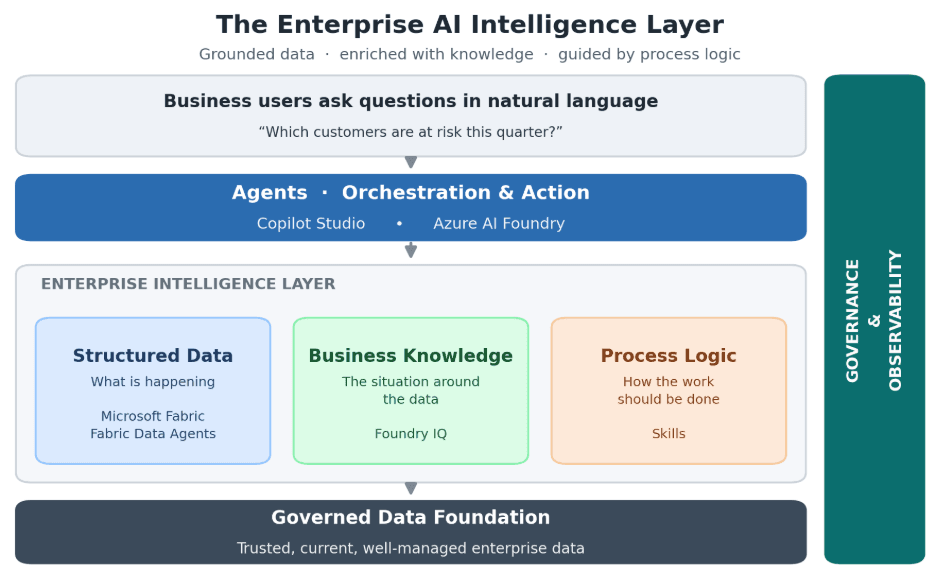
In the Microsoft ecosystem, the pattern maps onto concrete capabilities:
| Layer | Microsoft capability | Role |
| Governed data foundation | Microsoft Fabric | The trusted, governed data foundation |
| Structured data access | Fabric Data Agents | Structured data via natural-language questions |
| Business knowledge | Foundry IQ | Reasoning over documents and unstructured content |
| Orchestration & action | Copilot Studio · Azure Foundry | Where agents use the right tools and skills for the task |
The important point is not the product names. The important point is the pattern.
AI becomes more useful when it is grounded in trusted data, enriched with business knowledge, and guided by clear process logic. Without that, organizations risk building isolated copilots that are useful in demos but hard to scale into daily operations.
Governance cannot be added at the end
As soon as agents start using real data, knowledge, and process logic, governance becomes part of the architecture. It is not a separate workstream to be added later.
| Control — what an agent may do | Visibility — what an agent did |
| Which data sources can it use? | What did the agent do? |
| Which knowledge sources can it retrieve from? | Why did it give a certain answer? |
| Which skills are allowed to run? | Where is human approval required? |
| Whose permissions does it follow? |
This is what separates enterprise-grade AI from experimentation. The goal is not to have the most agents. The goal is to have agents that are useful, secure, observable, and aligned with how the organization actually works.
Where to start
The right starting point depends on the organization’s current maturity.
| If your starting point is… | The next step is… |
| Data foundation is still fragmented | Start with one valuable dataset and one clear business question. Build a governed foundation, expose data safely, and prove AI can answer real questions using trusted information. |
| Data platform already in place | Connect it to an agent use case. Don’t stop at reporting — show how a business user can ask a question in natural language and get a grounded answer where they already work. |
| Agents already exist | Focus on reuse, governance, and process knowledge. Are agents using shared data and knowledge layers, or is every agent its own isolated solution? Are key processes described clearly enough for agents to support them reliably? |
In most cases, the practical next step is not a large AI transformation program. It is one well-chosen business area where better decisions matter, where data and knowledge are readily available, and where the process can be described clearly.
About the Author: Mikko Koskinen, AI & Copilot Lead, Microsoft MVP

Mikko Koskinen joined Forward Forever in 2026 as AI & Copilot Lead, bringing over two decades of experience in the Microsoft ecosystem. A consultant, architect, and advisor at heart, he specializes in Copilot Studio, Copilot Agents, and the Power Platform, often stepping in as lead consultant or solution architect on complex modern work engagements. As a Microsoft Copilot Studio MVP, Mikko is a recognized voice in the community, frequently speaking at events and contributing to conversations around agent-based solutions and AI governance.