
Certification Exam Review and Guide: AB-620
Microsoft has been overdue for a proper Copilot Studio developer certification. Until now, professionals working with Copilot Studio had only one directly relevant applied skills credential, along with several certifications and applied skills that covered related topics. Now, Microsoft has introduced the Microsoft Certified: AI Agent Builder Associate certification. With it, developers building Copilot Studio agentic solutions finally have a certification to demonstrate their core competence. To earn it, you’ll need to pass the AB-620.
Nonetheless, many roles overlap with Copilot Studio agents, especially as AI becomes increasingly prevalent in the modern workplace, and this certification is not tailored to all of them. If you’re considering preparing for the AB-620, this post should give you a clearer idea of what to expect, how to prepare, and perhaps most importantly, whether the exam is right for you.
Is it for you?
AI Agent Builder is an associate-level certification, the middle tier in Microsoft’s Fundamentals/Associate/Expert scale. As such, it assumes those studying for it have a general technical background but does not require any other certifications to be completed in advance.
If you do not have a technical background, don’t dismay: You can still earn this certification, but you should expect to do additional study to help you understand some underlying concepts like HTTP requests and custom connectors, which will help you make sense of some of the tools. Copilot Studio is part of Microsoft’s Power Platform suite of low-code tools and, aside from a few more advanced configurations, is fairly accessible to less-technical users willing to take the time to learn it.
If you intend to build Copilot Studio agents and agentic solutions either as a hobby or in any part of your job role, this certification is perfectly tailored for your ends. Even if not, you may find this helpful if you work in a related area, such as building endpoints, managing data consumed by Copilot Studio agents, or managing a team that includes Copilot Studio developers. I cannot stress enough how helpful you will find it in IT to learn more about the roles of those working alongside you. Start with your core competencies, of course, but learning how what you do affects what they do (and vice versa) will make all your projects considerably smoother.
As such, I would recommend this certification primarily for anyone who works with or is interested in Copilot Studio. Additionally, I would recommend it for anyone who manages Copilot Studio developers or works with systems that interact with Copilot Studio agents. However, I recommend the certification to the latter groups as a supplement only after you have certified and trained in your primary area.
What can you learn?
A full list of topics appears in the official study guide. The gist of it is, however, that studying for this certification will prepare you to design, build, extend, and manage Copilot Studio agent solutions. Again, the focus here is on the advanced configurations. In practice, this means learning everything from using adaptive cards and topics to connecting to tools, MCP servers, and additional agents. The material also covers Copilot Studio computer use and best practices for choosing the right multi-agent scenario.
However, the focus is specifically on design, building, and monitoring. If your interest is in agent use, administration, adoption, or architecture, you should consider one of the following certifications instead:
- Copilot and Agent Administration Fundamentals (AI administration)
- AI Business Professional (AI use)
- AI Transformation Leader (AI adoption)
- Agentic AI Business Solutions Architect (AI architecture)
These topics will only be touched on lightly in the AB-620 material. Similarly, a wide range of AI-related certification options exist that do not address the Copilot Studio context as directly.
How can you pass?
As an associate-level exam, the AB-620 includes a link to Microsoft Learn directly within the exam interface. You can click that link and browse the documentation at any point during the exam to check relevant information. As such, you don’t need to feel pressured into memorizing every potential exam-relevant detail before sitting the test.
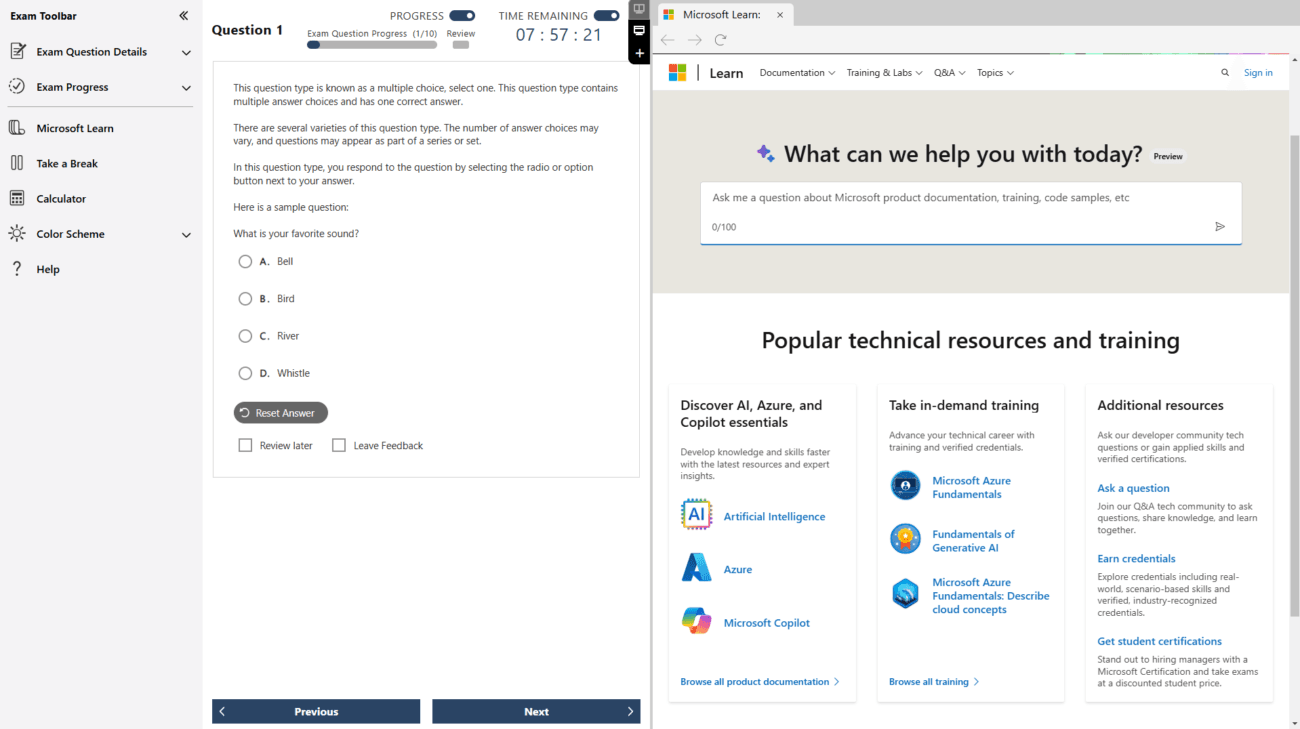
However, the search functionality during the exam is somewhat limited, and there is no CTRL+F option to find text on the page. AI summaries might pop up in search results spontaneously, but they do not provide an interactive chat and are mostly useful for confirming specific facts more quickly rather than for answering complex questions. As such, and considering the limited exam time, you should plan to use that feature sparingly. Your goal should be to get a broad, working understanding of the technology; then you can use the docs to confirm specific details and refine your knowledge on the go, exactly as you would in a real project.
As for what you should learn, following the Microsoft Learn study course for the certification will teach you most of what you need to know. However, if you do not have a Power Platform background, you can expect some crucial gaps for this one. Some questions on the exam relate to the broader Power Platform aspects of managing a Copilot Studio project, and these details are not covered in the Learn paths.
Depending on the questions you get, you may need to know about some of the following topics not covered by the course material:
- Power Platform ALM: Including managed and unmanaged solutions, solution layers, deployment pipelines, and environment types.
- Cloud flows: Including dynamic content, error handling, run after settings, and loop configuration.
- Environment variables: Especially secret variables but also other environment variable types and handling environment variables during deployments and between managed and unmanaged solutions.
If any of the above sound unfamiliar, I’d recommend learning more about those topics before sitting the exam. Likewise, review any unfamiliar-sounding topics listed in the study guide. Do that, in addition to reading the study materials in MS Learn, and you should be well prepared. Keep in mind all the usual tips for passing multiple-choice exams. You are not penalized for wrong answers.
Notes on the Beta Exam
Please note that I took this exam while it was still in beta. This was not my first beta exam, but this one had a lot more beta-related rough edges than the last beta exam I took, including some outdated questions, ambiguous language, and some questions with the wrong answer type (such as a “Put the actions in order” question that should have been a multi-select multiple choice question. The actions in the question could be performed in any order). This is always a risk when taking exams before the release date.
Since the exam is now in GA, most of these issues should be resolved, but I cannot retake it to confirm. Just be aware of the possibility and remember to leave feedback if you encounter any issues. The longer you’re taking the exam from the release date, the less likely this is to be relevant.
Furthermore, because Microsoft can always update their exams, especially when moving from the beta to general availability, you should always refer to Microsoft’s official study guides for the most up-to-date information about exam contents.
Summary
The AB-620 is an associate-level exam that provides a well-rounded test of your skills in managing, developing, and extending Copilot Studio agentic solutions. It is the best certification for anyone building Copilot Studio agents beyond the simplest, declarative designs. It can also be helpful for IT professionals working with systems that link to or are consumed by Copilot Studio agents to better understand the integrating systems. Managers of Copilot Studio agent dev teams may also benefit from the additional context in how agent development works in practice. To better prepare for the exam, check the Learn materials and review the study guide. Further, ensure you feel confident working with the more foundational Power Platform resources, especially flows, environment variables, and solutions.
Overall, I found the AB-620 to be a worthwhile and much-needed addition to Microsoft’s certification portfolio, filling a gap that has existed since Copilot Studio emerged as a serious development platform. If you’re looking to build Copilot Studio agents, or if you already build them and want to validate your skills, this is a great place to start.
This was really helpful. Thanks!
Glad to hear it! Good luck with the exam if you’re going for it.