
Fabric Apps: Building the App Was the Easy Part
Building the app was the easy part.
I didn’t expect to write that.
I’m in no way an application developer and before Fabric Apps I never built one. My background is in Power BI, Fabric, governance and understanding the business problems they can solve. While I’m comfortable describing what a useful solution should do, turning those requirements into a working application has traditionally been somebody else’s job.
One thing I’ve learned from doing governance is that finding the data gaps is usually the easy part. Ownership information is missing, business context is unclear and reports or semantic models exist with little explanation of what they are intended for. Fabric and Power BI are very good at helping us discover those gaps. They are much less helpful when it comes to fixing them. The result is often a collection of Excels, forms and separate processes that sit outside of the platform they are intended to support.
Fabric Apps provided an interesting way to test whether that could change. The starting point was a common customer need: how do you give users a catalogue of their Fabric assets while also allowing them to improve the information behind it? The resulting application allowed users to browse workspaces, semantic models and reports, while also adding ownership, metadata and business context directly alongside them. The catalogue itself was not the interesting part. The interesting part was allowing users to move directly from discovering information to improving it.
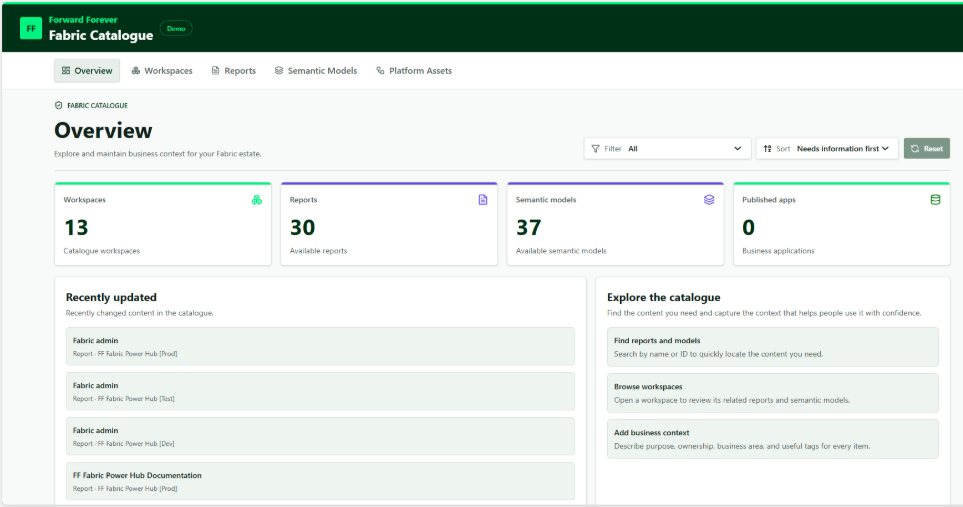
The finished Fabric Catalogue brings Fabric assets into one business-friendly application.
I expected the development to be difficult. It was not.
The real issues were elsewhere. Preview limitations, publishing options and regional availability were ultimately more challenging than building the application. Building a working solution turned out to be surprisingly straightforward. Turning it into something I would confidently recommend for production is where the platform still has ground to cover.
Surprisingly, the AI-assisted development experience felt more mature than some of the Fabric capabilities around it.
A working app in a day
What actually surprised me was not that the application worked. It was how quickly it worked.
When I started building the first version of the Fabric catalogue, the goal was quite modest. The plan was to create a simple UI for users to browse Fabric assets and see what existed in the environment. Rather than demoing the solution through screenshots or mock-ups, the app provided a functioning user experience and interaction from the outset.
What surprised me was how quickly the idea became working software. With GitHub Copilot, a Fabric App template and, most importantly, an existing Fabric catalogue semantic model with real production data, I had a working prototype in roughly a day.
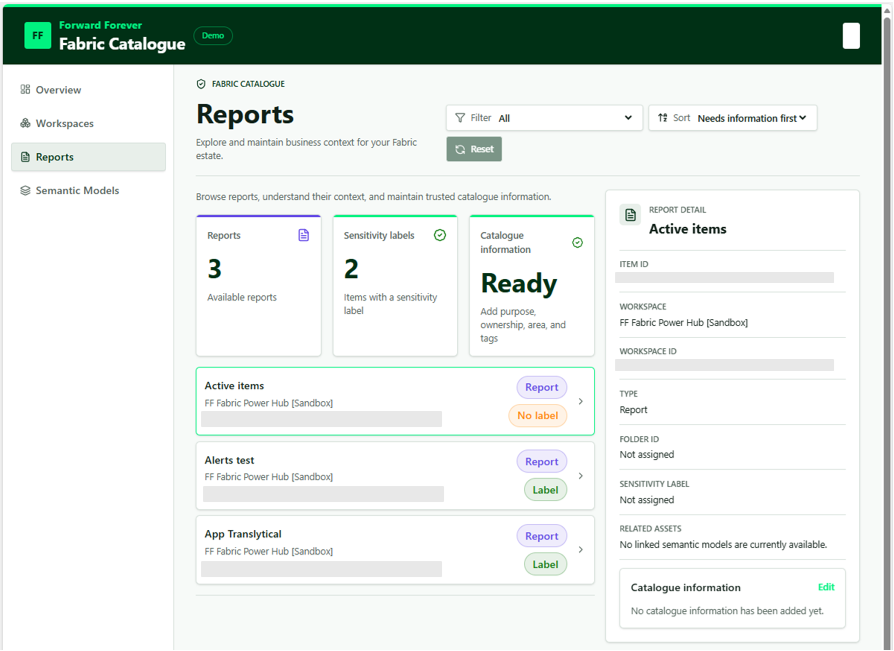
The first prototype provided a working overview of Fabric assets and their metadata.
The initial experiment had already been a success. In a surprisingly short time, I had gone from an idea to a working app connected to real Fabric data. The next question was what to do with it. Could it be improved enough to become a solution I could present to customers?
Making the catalogue useful
With GitHub Copilot, I continued building on the prototype. During the next day, I added and tested the write-back functionality, added AI suggestions based on metadata and changed the interface into a more familiar table layout
The first addition was the write-back. Viewing information is useful, but as stated before, that could be achieved with Fabric and Power BI already. Allowing users to add or edit ownership information, business descriptions and other contexts directly from the catalogue was one of the key drivers for building the app.
More importantly, the write-back functionality made it possible to add information that couldn’t be added in Power BI or Fabric natively. Business ownership and area, technical contact and tags are all data that doesn’t exist at the workspace, report or semantic model levels in Fabric.
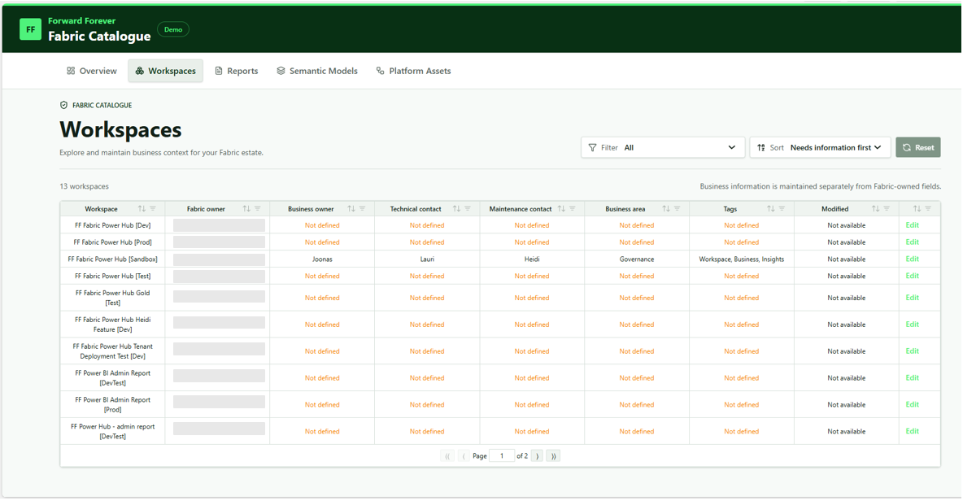
The tabular catalogue makes missing ownership, contact, business-area and tag information immediately visible.
I added the next improvements in a couple of prompts. Data persistence was added so the changes remained available across sessions. AI-assisted suggestions were added, so the app itself could help identify missing metadata and propose values for the user to review and add.
Finally, I gave Copilot a snip of an existing data catalogue from Dynamics and asked it to rebuild the interface as a table while keeping the existing functionality. These additions worked without requiring major changes to the original app.
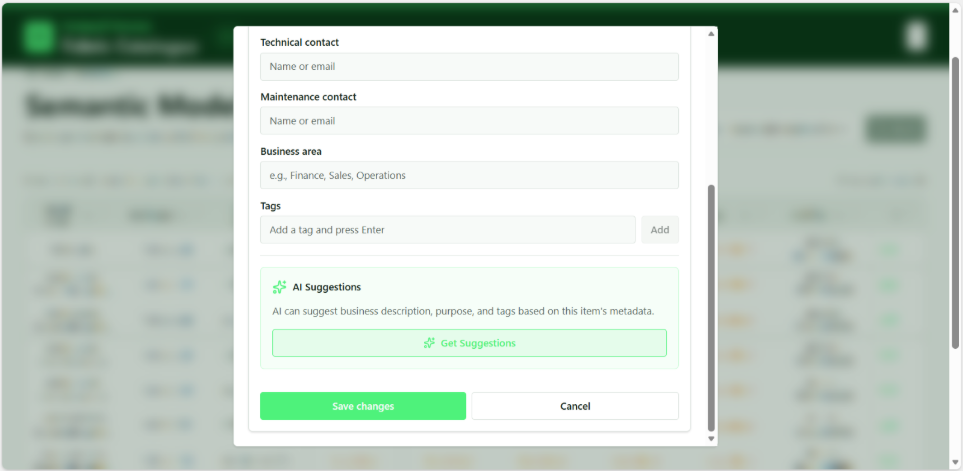
AI proposes catalogue information, but the user reviews and explicitly saves every change.
The limitations were outside the app
Most of the challenges that I encountered had nothing to do with the actual AI-assisted development. The building of the initial prototype was smooth, and the ensuing additions and changes didn’t cause any friction either. The harder questions were related to what the production-grade application would look like in Fabric. The application felt almost ready, but the platform around it was not as mature.
The application relied on the only available write-back pattern, a solution backed by a Fabric SQL database. Publishing was also limited to only the workspace that housed the application. Regional availability was also a bit lacking. The Fabric Apps preview wasn’t available in our primary region of North Europe, which required using West Europe to build the application. This also presented a direct challenge in proposing Fabric Apps projects to customers as most of them also resided in North Europe.
At that point the development was ready for customer presentation, but the surrounding platform was not there yet.
What FabCon changed
Then FabCon Europe 2026 in Barcelona happened. Amongst the flood of new features, updates and announcements, Fabric Apps was the highlight. The announcements addressed nearly all the platform challenges I had encountered and provided a clearer roadmap for Fabric Apps.
Fabric Apps related announcements covered application-facing APIs, expanded discovery capabilities in OneLake Catalog, richer search experiences, MCP integration, governance improvements, as well as deployment and publishing capabilities. And of course, Fabric Apps finally became available in North Europe.
The message was clear. Fabric Apps will be a key part of Fabric development going forward. Most importantly, general availability now seems closer than it did a month ago. Features that had previously been discussed in quarters could now arrive within months or even weeks.
More than an analytics platform
What started off in 2023 as an analytics platform has quickly evolved into much more. Today Microsoft calls Fabric a “unified AI platform that brings together data and analytics.” With Fabric Apps the platform is truly evolving from analytics toward applications.
This shift expands what can be built on top of data. Instead of using Fabric to analyze information through reports and dashboards, organizations can now turn the same data into interactive applications. Also, these applications are built on Fabric’s existing data layer, business logic, governance and security.
The Fabric Catalogue is only one example of this change. The app itself doesn’t truly matter. How little time, effort and additional infrastructure was needed to transform an idea into something usable is the significant part. The distance between an idea and a working solution has been shortened to only days in my case and probably even hours for some.
The development is ready, the platform is not
FabCon didn’t make Fabric Apps ready for production overnight. Fabric Apps is still in preview and while many questions were answered, there is still work to be done before it can be confidently used in production. Timelines and roadmaps can also change.
Nevertheless, the direction is much clearer now. The Fabric Catalogue showed me that useful applications can be built in Fabric. The remaining question is how quickly the platform around them will mature. FabCon suggests that Microsoft is working on it relentlessly.
Ultimately, the development experience feels ready. The platform is still catching up, but Fabric is already starting to look like an application platform, not only an analytics platform.